Jumi combines the principles of judo with mindfulness, thus the word jumi is an acronym for judo mind.
Jumi Tree Breathing Techniques can be used to reduce stress, anxiety and fear, as well as to expand your consciousness and enhance your healing potential.
The following facilitated session is an extract from a live online training with Jevon Dängeli:
Explore other versions of Jumi Tree Breathing and related techniques: https://jumi.live/jumi-tree-breathing-technique
Jumi promotes open awareness and healing by engaging the body in energy flowing movements and conscious breathing.
Jumi combines the principles of judo with mindfulness, thus the word jumi is an acronym for judo mind, however there is more to it…
Judo means the gentle way in Japanese. This martial art was founded by Professor Jigoro Kano, based on the principles of effective use of energy – maximum efficiency with minimum effort, as well as mutual welfare and benefit.
Similar to judo and aikido, jumi involves mental and physical training, emphasizing the ability to relax the mind and body even under the stress of dangerous or uncertain situations.
Jumi can be understood as the inner game of judo. The goal of jumi is to make the inner and broader benefits of judo useful to children and adults in all spheres of life.
“Ju” 柔 in Japanese stands for adaptability, agility and maximum efficiency with minimal effort.
“Mi” 実 has several meanings in Japanese, including: essence, reality, truth, and good results.
Jumi 柔実 directly translated means pliability (adaptable to change).
In order to be successful in any pursuit, one must be adaptable to change. Practising jumi develops mindful adaptability, which in turn leads to openness, flexibility and efficiency –
– open to all aspects of your present reality
– flexible body & mind (perspective & attitude)
– efficient (spontaneous, purposeful, respectful) actions
Jumi sessions involve the following activities:
- Jumi sequences
- Open Awareness training
- Authentic Self Empowerment
- Mindfulness based stress reduction
- Attention shifting & focusing
- Concentration techniques
- Conscious breathing skills
- Qigong related practice
- Yoga exercises
- Judo – playful
Essentially, jumi training promotes empathic resonance (capacity to attune with others), eco-logical (win-win-win) motivation and efficiency, through embodying the state of open awareness. The core objective of jumi is to develop open awareness (embodied mindfulness) and the ability to maintain it in all contexts.

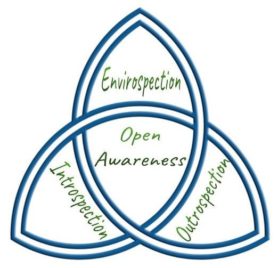
Open Awareness (OA) is a mindful mode of perception accompanied by a calm, receptive and resourceful state. Furthermore:
- OA cultivates metacognitive introspective awareness – in which the mind can observe its own state and activities – an awareness of the mind itself.
- OA enhances extrospective awareness – sensory perceptions and somatic experience.
- OA reframes one’s current experience of self, placing phenomena within one’s awareness, as opposed to these being experienced separate from oneself. This reduces distress, enhances intuition and promotes a sense of interconnection.
In order to develop OA and have this state available in challenging situations, it needs to become embodied. Jumi has been created for the purpose of embodying open awareness.
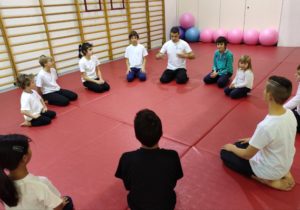
Embodied OA leads naturally to self-empowerment and a purposeful presence that is beneficial to those around you. This upholds Jigoro Kano’s principles of judo, transferring them from the dogo to the world.
While jumi serves as a mind-body practice by itself, it can also be used to compliment other integral practices. There are jumi sequences suitable for young to old, at any level of fitness and psycho-spiritual development.
Introduction to jumi video.
Discover more about jumi: https://jumi.live/concept-practice